
Most agencies treat the airport transfer as the last line on the itinerary — booked in five minutes from whichever platform is already open, at whatever it costs, and forgotten until something goes wrong. That instinct made sense when transfers were a courtesy add-on thrown in after the flight and the hotel. It stopped making sense some time ago.
The transfer is now the leg your client is most likely to remember, the one you are most likely to be blamed for, and — depending on how you source it — one of the better-margin items on the booking. It is also the only part of the trip where you often cannot name the company that will actually show up.
Here is how agencies source ground transportation in 2026, what “vetted” means in each channel, and how to build a supplier list you can defend.
The four ways agencies source ground transportation
There are four channels, and the choice between them is a trade of margin against control against effort. Every agency uses at least two.
| Channel | What you get | What it costs you |
|---|---|---|
| Transfer aggregator (HolidayTaxis, Mozio, GetTransfer, Intui) | Instant global coverage, one booking flow, one invoice | The margin is set by the platform, and the performing operator is usually hidden from you |
| Operator-direct programs | A negotiated rate and a named contact who answers the phone | One company, one metro area — you need dozens to cover a client base |
| Consortium preferred suppliers (Virtuoso, Signature, Ensemble) | Pre-negotiated terms, vetting done by the consortium, luxury-tier service | Membership is required, and the supplier list is narrow by design |
| Network directories | Search by city, see credentials, contact the operator yourself | You do the outreach and negotiate your own terms |
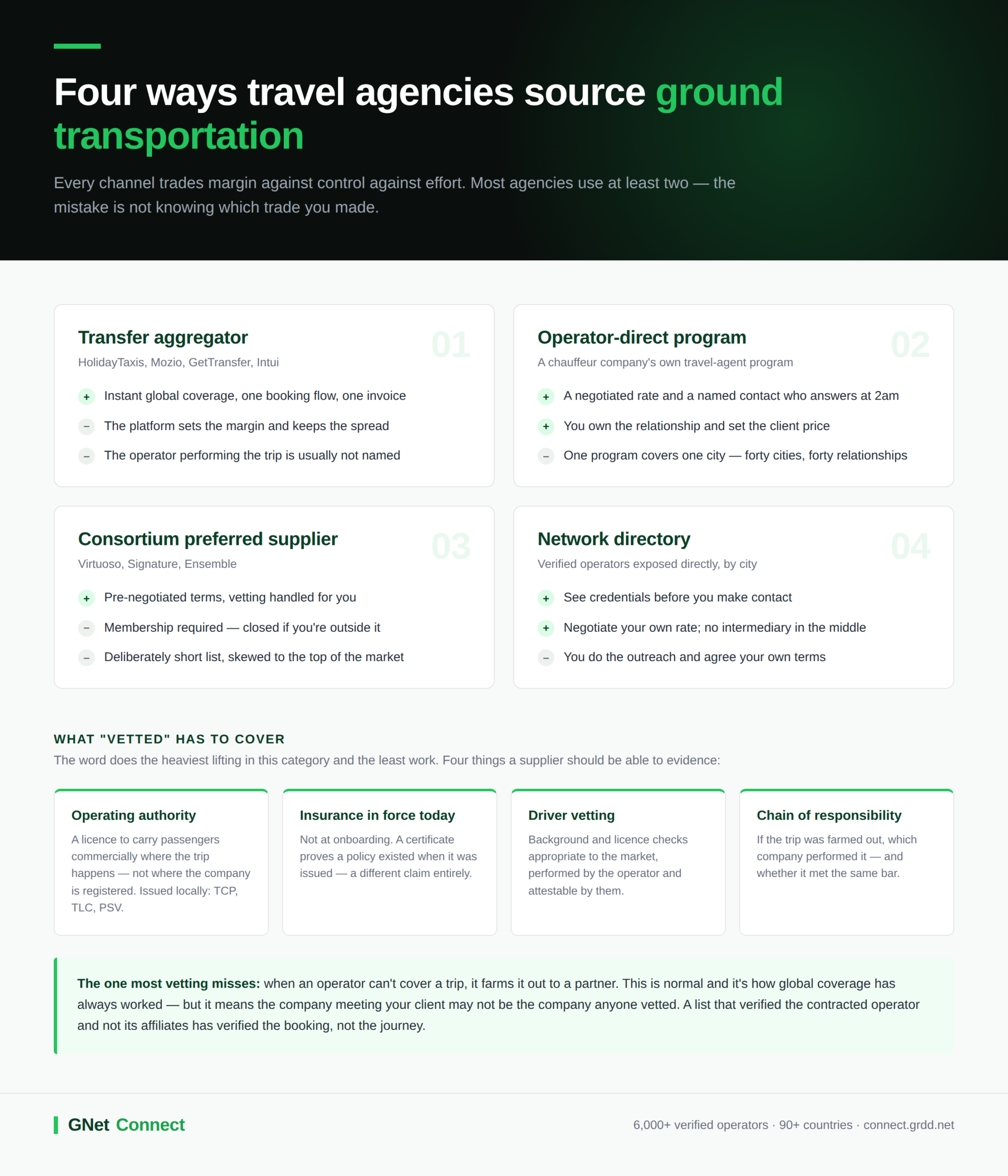
Aggregators solve the coverage problem in one step, which is why almost every agency starts here. You search a city, you get a price, you book. The trade is opacity: you are buying from a platform that bought from someone else, the spread belongs to the platform, and the company meeting your client at arrivals is typically not named anywhere in your confirmation.
Operator-direct programs are the opposite trade. A chauffeur company with a travel-agent program gives you a real relationship, a negotiated rate, and someone accountable when a flight lands at 2am. The limit is arithmetic: one program covers one city well. Covering forty cities means forty relationships.
Consortium preferred-supplier lists do the vetting for you and come with pre-negotiated terms — Rolzo and EmpireCLS both sit on Virtuoso’s list, for example. If you are a luxury advisor inside a consortium, start here. If you are not, this channel is closed, and even inside it the list is deliberately short and skews toward the top of the market.
Network directories are the newest of the four and the least understood. Rather than selling you a booking, they expose the operator layer directly — who covers a city, what credentials they hold, and how to reach them. You keep the relationship and set your own terms; you also do the work of making contact.
What “vetted” actually means — and who is doing the vetting
“Vetted” is the hardest-working word in this category and the least examined. Every channel above uses it. Almost none of them tell you what it covers.
Three questions cut through it: which documents were checked, how recently, and does the check extend to the company that will actually perform the trip.
A supplier who can support your duty of care can evidence four things:
- Operating authority. A licence or permit to carry passengers commercially in the jurisdiction where the trip happens — not where the company is registered. This is issued locally: TCP in California, TLC in New York City, PSV and operator licensing across the UK and Europe. There is no global register to check.
- Commercial insurance in force on the travel date. Not at onboarding. On the day. A certificate proves a policy existed when the certificate was issued, which is a different claim entirely.
- Driver vetting. Background and licence checks appropriate to the market, performed by the operator and attestable by them.
- The chain of responsibility. If the trip was passed to a partner company, which company performed it — and whether it met the same bar.
That fourth point is where most vetting quietly stops.
The part nobody explains: your transfer may be subcontracted
When an operator cannot cover a trip — wrong city, wrong vehicle, already committed — it farms the trip out to a partner operator. This is normal, legitimate, and the only way the industry has ever achieved global coverage. Every serious chauffeur company does it, including the ones on consortium lists.
It also means the company that meets your client may not be the company anyone vetted.
This is not an argument against farm-out. It is an argument for knowing whether it happened and who performed the trip, because a supplier list that verified the contracted company but has no view of its affiliates has verified the booking rather than the journey. When you ask a supplier how they handle subcontracting and the answer is vague, you have learned something important.
The terminology trap
Before you search for anything, know that “ground operator” does not mean what you think it means.
In travel-trade usage, a ground operator is a receptive or inbound tour operator — a local company handling transfers *plus* tours, guides, and hotel logistics. It is close to a DMC. A chauffeur or transfer company is a subset of that, and often not what a “ground operator” sells.
If you need airport transfers and executive car service, the vocabulary that finds you the right supplier is transfer supplier, airport transfer partner, chauffeur service, or private car service — not “ground operator.” Searching the wrong term is the most common reason an agency ends up on a tour-packaging call it did not want. (We break the distinction down in ground operator vs DMC vs chauffeur network.)
What you can charge, and what each channel lets you keep
There are three ways an advisor makes money on a transfer, and the channel determines which are available.
- Supplier commission — the operator or platform pays you a percentage of the sale.
- Net-rate markup — you are quoted a net rate and set the client price yourself.
- Service fee — you charge the client for arranging it, independent of the supplier.
Published 2026 ranges put private sedan transfers around 18–22% at standard margin and luxury vehicles at 25–30%, with group and coach work in between. Those are the numbers to benchmark against, not to assume.
The channel matters more than the headline percentage. A commission paid on an aggregator’s retail price is calculated after the platform has taken its spread. A net rate negotiated directly with an operator lets you set the client price and keep the difference — usually the better outcome on repeat routes, and always the better outcome on volume. Consortium terms are pre-negotiated, which removes both the work and the upside.
Worth stating plainly: rates and payment are settled between you and the operator. A directory or network that connects you to a supplier is not a party to that transaction and does not set your margin.
Building a supplier shortlist, city by city
A workable process, in the order that saves the most time:
- Start with your actual demand. Pull the ten cities your clients land in most. Not the forty you might need one day.
- Find three candidate operators per city. Two is not enough for peak coverage; five is more relationships than you will maintain.
- Check credentials before you make contact. Licence, permit, insurance currency. If you cannot see them without an introductory call, treat that as a data point.
- Send one email with the five questions below. The quality and speed of the reply tells you more than the website did.
- Test with a low-stakes booking. A daytime airport pickup with a forgiving client, before you trust it with a board director at midnight.
- Recheck annually. Licences and policies expire on their own schedule, not yours.
Five questions to ask any ground transportation supplier
- How do I confirm your insurance and licence are current today? If the answer involves emailing someone and waiting, that is not a control.
- What happens when the trip is farmed out? Ask directly whether affiliates meet the same bar, and how you would learn which company performed a given trip.
- What are your net rates, and what do you pay on commission? Both numbers, so you can compare channels honestly.
- Who do I reach at 2am when a flight diverts? A name and a number, or it does not exist.
- How far outside this city do you cover, and who covers it for you? This is the coverage question and the subcontracting question at once.
Where GNet Connect fits
GNet Connect is a free directory of 6,000+ verified ground transportation operators across 90+ countries and 150+ markets. It is not a booking platform and does not sell trips — it exposes the operator layer so an agency can find, verify, and contact suppliers directly.
How agencies use it:
- Search by city and service type — sedan, SUV, group, executive.
- Review verified credentials — insurance certificates, operating licences, and permits, with verification reflecting whether documents are current rather than whether a PDF was once uploaded.
- Contact the operator directly and negotiate your own rates and terms.
- Keep the relationship. No intermediary sits between you and the supplier, and no platform takes a spread on your margin.
Verification is the substance here rather than a badge: certificates are checked against insurance systems, licences and permits are tracked by issue and expiry date, and operators are reminded before documents lapse — so a supplier list stays accurate between renewals instead of decaying quietly. The detail is in how GNet verifies operators, and the agency-specific picture is on transfer suppliers for travel agencies.
FAQs about finding and vetting transfer suppliers
How do travel agencies find reliable private car services for clients internationally?
Four channels: transfer aggregators, individual operators’ travel-agent programs, consortium preferred-supplier lists, and network directories that expose verified operators by city. Aggregators are fastest to start with; direct relationships and directories give better margin and more control over who actually performs the trip.
Is there a directory of vetted chauffeur companies worldwide?
Yes. GNet Connect lists 6,000+ verified ground transportation operators across 90+ countries, searchable by city and service type, with insurance certificates, licences, and permits verified and tracked for currency.
Do transfer suppliers pay travel agent commission?
Many do. Published 2026 ranges are roughly 18–22% on private sedan transfers and 25–30% on luxury vehicles at standard margin, though the more common arrangement with direct operator relationships is a net rate you mark up yourself.
How can I verify a chauffeur company’s insurance and licence in another country?
Ask for the operating licence or permit issued in the city where the trip takes place — not where the company is registered — and a certificate of insurance with the policy period. Licensing is local (TCP in California, TLC in New York City, PSV across the UK and Europe), so there is no single global register. A network that tracks document expiry dates removes most of this work.
What are the alternatives to GetTransfer, Mozio, or HolidayTaxis?
Aggregators price and resell the trip, keeping the spread and usually the operator’s identity. The alternative is sourcing the operator directly — through their own travel-agent program, a consortium list, or a verified directory — so you negotiate your own rate and know which company is performing the journey.
Is a “ground operator” the same as a chauffeur company?
No. In travel-trade usage a ground operator is closer to a receptive tour operator or DMC, handling transfers alongside tours, guides, and hotel logistics. If you need airport transfers and car service specifically, search for transfer suppliers or chauffeur companies instead.
Sourcing ground transportation for your clients?
GNet Connect is a free directory of verified transfer suppliers — 6,000+ operators across 90+ countries, with insurance, licences, and permits verified and kept current. Search by city, check credentials, and contact operators directly.
Leave a Reply